Showing posts with label Ellis Postcard Company. Show all posts

Saturday, June 2, 2012

'Darrington, Wash., on the Great Northern R.R.'

Another one of those head scratchers -- there may well be thousands of these postcards, and variations thereof, still in existence:


Notice anything odd?

Some early enterprising photographer rushed to get this view of Whitehorse mountain and a young Darrington onto the postcard carousels at newsstands, post offices and general stores around the Puget Sound region.

The only problem? The Great Northern Railway never had a route to Darrington. It was the Northern Pacific Railway that built a branch route to Darrington, arriving there in June 1901.

The error continued on several variations of the postcard, including this Puget Sound News Co. version below; its divided back and German origin indicates it would have been published between 1907 and 1915.


Lowman & Hanford Co., a Seattle postcard publisher in business from 1894 to 1955, continued the error on the hand tinted color version below, probably produced between 1915 and 1930.


I don't think the error was ever corrected, as I have never found any newer versions of this card — which is not surprising. Postcard companies routinely updated their images every few years as towns and landscapes changed.

Perhaps Lowman & Hanford commissioned a photographer to return to Darrington to take a new photo — or maybe they gave up on producing postcards of the northwestern Washington region when Arlington's J. Boyd Ellis of the Ellis Postcard Company began producing higher quality real photo postcards.

Monday, May 28, 2012

For Memorial Day: A view of Lions/Legion Park


In honor of Memorial Day, here is an Ellis Postcard Co. real photo post card depicting Arlington's Lions Park in the 1940s, what we now know as Legion Park.

The top photo points north, showing a sign advertising Murphy's Feed Store, founded in 1892. Murphy's burned down some time in the late 1980s or early 1990s. The grain elevator and the Northern Pacific depot would have been to the left (west) of that building, just out of camera range; City Hall would be to the north of the feed store, if I recall correctly.

Today the one constant in both photos is the service memorial now maintained by the American Legion, hence the park's name.

Now the memorial is joined by the new gazebo, built almost entirely from donated material and labor, as well as the new Arlington Depot visitor's center, and the Centennial Trail. The park finally feels like a true community gathering place... but still stands as a place to remember our fallen service personnel.

Thursday, May 3, 2012

Canyon Creek Lodge, Granite Falls

Today's entry is a quickie: two postcard views from early Ellis real photo post cards.

#2027, Interior Paul Bunyan Hall, Canyon Creek Lodge.


#2000, Canyon Creek Lodge, exterior view. Probably 1940s.


The Canyon Creek Lodge, located in Granite Falls, opened in 1918. By chance I actually found a full article on the history of the lodge.

The original lodge burned in 1938, and was rebuilt -- but burned again in the 1960s.

This image has fascinated me for a long time. The days of rustic lodges and resorts like this seem to be long gone.

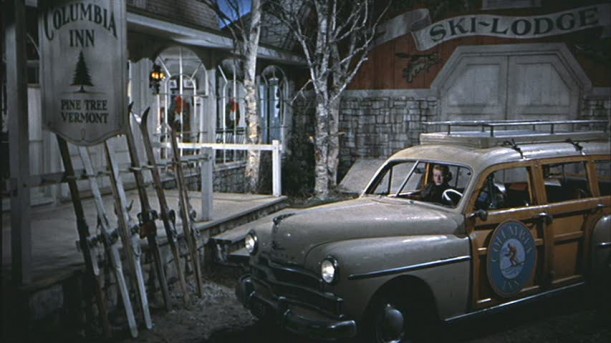
Yes, you can still find such locations that offer what you think is an "all encompassing" experience... but when is the last time you got dinner, dancing and a floor show in your guest package, like you would at the Columbia Inn in Pine Tree, Vermont?

"Vermont should be beautiful this time of year, with all that snow."


Yes, that Columbia Inn, from the film "White Christmas."

I have more images of long gone local resorts which I'll be sharing along the way; stay tuned.

Saturday, April 7, 2012

Three views of Arlington, part three

For the final views of Arlington's historic "Old Town," I sadly only have two images, which have a lapse of some 40 or more years between them. Perhaps some kind soul out there might have a view of Olympic Avenue from the 1970s or 1980s (although this was an era when many of the historic building facades were replaced with "modern" -- but much less attractive -- architectural detailing).


This view is from sometime in the 1960s, again showing the "heart" of downtown, E. 3rd Street and Olympic Avenue. The brick building is still in place on the northwest corner. City Hall is situated on the southwest side, which at the time also housed the police and fire departments (remember, at this time Arlington's population was approximately 2,500).


This final view of Arlington's historic "Old Town," was photographed by yours truly in March 2008, and shows the results of the completed street resurfacing that had taken place over the course of a two year period.

Arlington is truly an example of the adage "the more things change, the more they remain the same." While there were obviously significant changes in the structures along Railroad/Olympic in the first half of the 20th century, not much has changed since then. While the town has grown to a population of more than 17,000, "Old Town" remains ageless, in a way. That is a rare quality in this day and age.

If you missed the earlier views, part one is here; and part two can be found here.

Friday, April 6, 2012

Three views of Arlington, part two

In the second era of Arlington's downtown core, Railroad Avenue became Olympic Avenue, and was photographed extensively by J. Boyd Ellis and his son Clifford of the Ellis Postcard Company*, located right here in Arlington.

Here are three Ellis views of the intersection of Olympic Avenue and E. 3rd Street.


The first view shows more of the east side of the intersection, and by the looks of the cars on the street, may be from the 1930s (before there was a stoplight). Just out of the screen shot to the left is City Hall.

The second and third views look to be taken sometime in the 1940s, based on the cars in the photo. The third view provides a better glimpse of the City Hall building.

If you missed part one, click here.

*Boyd and his son Clifford were prolific postcard photographers for the better part of half of the 20th century, documenting towns and landscapes from Washington, Oregon, California, Idaho and beyond. I will be writing about them more as this blog progresses.